
"About as Hands-On as it Gets:" Trisha Daughtrey Leads Students as They Assist Locals in Cal Poly's Two Tax Clinics

One of the most rewarding aspects of leading Cal Poly’s two tax clinics, said Trisha Daughtrey, is getting to watch the students grow as humans and empathize with clients who might have struggles.
“They’re learning from meeting people,” she said. “A lot of these students are getting exposed to a population they’re not aware of here in San Luis Obispo.”
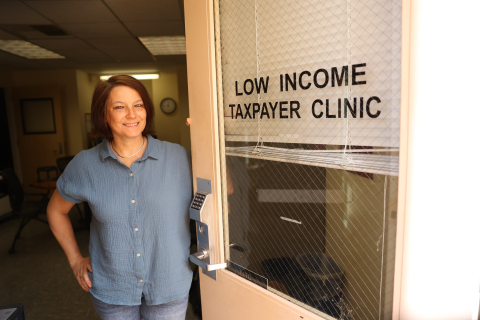
Daughtrey is the director of both the Volunteer Income Tax Assistance program (VITA) and the Low Income Taxpayer Clinic (LITC). She has headed VITA since 2014, and she became director of the LITC this year, replacing Lisa Sperow, who is now president and CEO of Monterey College of Law. Both clinics feature students helping members of the public – VITA workers help individuals file taxes, and LITC helps members of the community facing tax debts.
“LITC is similar to VITA in the sense that we help the community,” Daughtrey said. “It’s about as hands-on as you can get. We’re working with real clients with real tough situations."
Growing up in a low-income family in the Central Valley, she said, she emphasizes with many of the clients.
“It’s hard for me to watch the struggle, and it’s hard that the tax laws are so complicated,” she said.
After high school, Daughtrey attended three different community colleges before transferring to Cal Poly, where she studied accounting.
“I literally took an aptitude test, and it said, ‘Based on your answers, you should be a CFO,’” she said. “And I was, like, ‘What does CFO stand for?’”
After college, she worked as a financial analyst for Moonstone Hotel Properties in Cambria, then eventually worked for REC Solar as accounting manager.
“I was with them for three years, and that’s when I realized I wanted to be a CPA,” she said.
She earned her CPA license and performed public accounting work. In 2013, she joined the Orfalea College of Business as a lecturer, teaching financial accounting. With her tax background, she was asked to assist Jack Robison and Janice Carr in running VITA.
“I personally was ecstatic as both of these amazing humans were my professors when I attended Cal Poly, so I felt very honored and proud to be working next to them as colleagues,” she said. “After the winter quarter 2014 ended, Jack said ‘I think we finally found someone to take over the program,’ and they retired.”
As she led VITA, Daughtrey earned a master's degree in accountancy through Golden State University in 2019.
While the LITC is a year-round clinic, VITA operates during tax season – this year, from Jan. 31 to March 14. While VITA assists those with gross incomes under $70,000, filing taxes can still pose a challenge for clinic clients.
“Tax law isn’t getting any easier, it’s just getting more and more complicated,” Daughtrey said.
“It’s about as hands-on as you can get. We’re working with real clients with real tough situations."
Trisha Daughtrey, director of Cal Poly's tax clinics
As an example, she said, when this year’s clinic began, tax filing software had not yet been updated for the new “No Tax on Tips” law.
“A lot of our clients earn tips,” she said. “We need the software to work.”
Clients can also get confused over insurance requirements (California penalizes those not covered), the earned income tax credit and itemized deductions.
While taxes can be complicated on their own, some clients have contributed to their problems.
“We do have clients trying to cheat the system, so I have to keep my spidey senses,” Daughtrey said.
One LITC client, she said, had changed his name six times. “He said, ‘I keep changing my name, and they keep finding me.’”
Some of the clinic students are paid, while others are getting class or senior project credit. Either way, it’s an excellent opportunity for students to have an impact on communities.
Suyeon Hwang, who has worked at both clinics, said working with VITA offers education with real-life scenarios.

“It teaches you to bear responsibility and hold yourself to a professional standard, which is a key part of being an accountant,” Hwang said. “LITC is also a Learn by Doing program that teaches you similar skills. What is unique about it is the legal aspect of taxation. This program helped me gain an understanding of the overall tax system, which includes more than preparing taxes every year.”
Linzee Lee has also worked at both clinics, sharpening her accounting skills.
“I would say both clinic experiences have developed my ability to work within fast-paced environments and think fast for solutions on the spot,” Lee said. “LITC has helped me develop my critical thinking and organizational skills. VITA has helped with getting me re-familiarized with tax schedules and laws and prompting me to develop my tax knowledge.”
As new LITC director, Daughtrey said she too has to sharpen some skills, increasing knowledge of tax law and grant writing.
“It has been a huge learning curve for me because I’m not an attorney,” she said, noting that most LITC clinics operate out of law schools.
Outside of work, she is a mother of three, who spends time with her children and wife. She is also the accountant for Camp Natoma, a youth summer camp on the Central Coast, and has worked part-time as CFO for Splash Café since 2020.
When she’s not working, she loves to rock climb, play racquetball and pickleball and is an overall lover of sports.
“I’m obsessed with football,” she said. “My favorite day of the year is the Super Bowl.”
Top photo: Trisha Daughtrey assists a student worker in the Low Income Taxpayer Clinic. (Photo: Pat Pemberton)

