
In Four Years, College Seniors Have Witnessed a Drastic Change in How We View Artificial Intelligence in the Classroom

When fourth-year marketing student Taylor Kirk first entered college, much of the discussion around artificial intelligence focused on how students might use it to cheat.
“I would have thought it was ethically wrong to use it in class,” she says, sitting in her Marketing Strategy course, which uses AI to enhance storytelling and strategy.
Because AI has evolved so quickly and become so prevalent in the workforce, universities like Cal Poly are now encouraging it, marking a dramatic shift for seniors who had a different experience as freshmen just four years ago.
“Universities have moved from treating AI as a threat to academic integrity to recognizing it as a foundational skill for learning, research and professional practice,” said Stern Neill, a marketing professor who teaches Kirk’s BUS 455 course. “Early responses were reactive; now the conversation is shifting toward literacy, responsible use and preparing students for AI-augmented careers.”
The origin of AI dates back to 1956, when the Dartmouth Summer Research Project on Artificial Intelligence explored how machines could simulate human thinking.
In more recent years, technological innovations – including greater computing power and the internet’s ability to gather large sets of data – have accelerated at warp speed. While fears of AI’s negative potential are still valid, the technology’s ability to simplify tasks has made it increasingly in demand. As a result, 78 percent of organizations used AI in 2024, up from 55 percent just the year before, according to Stanford University’s Human-Centered Artificial Intelligence.
Even though higher education isn’t always wired for rapid entrepreneurial shifts, Neill said, educators have to incorporate it into their lessons.
“I adopted it out of necessity for student preparation,” he said. “Employers now expect graduates to be fluent in AI-augmented work. A senior manager recently told me, ‘When we hire, all our interview questions are about AI -- how you use it personally and professionally. We want people who help innovate and push the team forward, not maintain the status quo.’ That mindset is becoming common.”
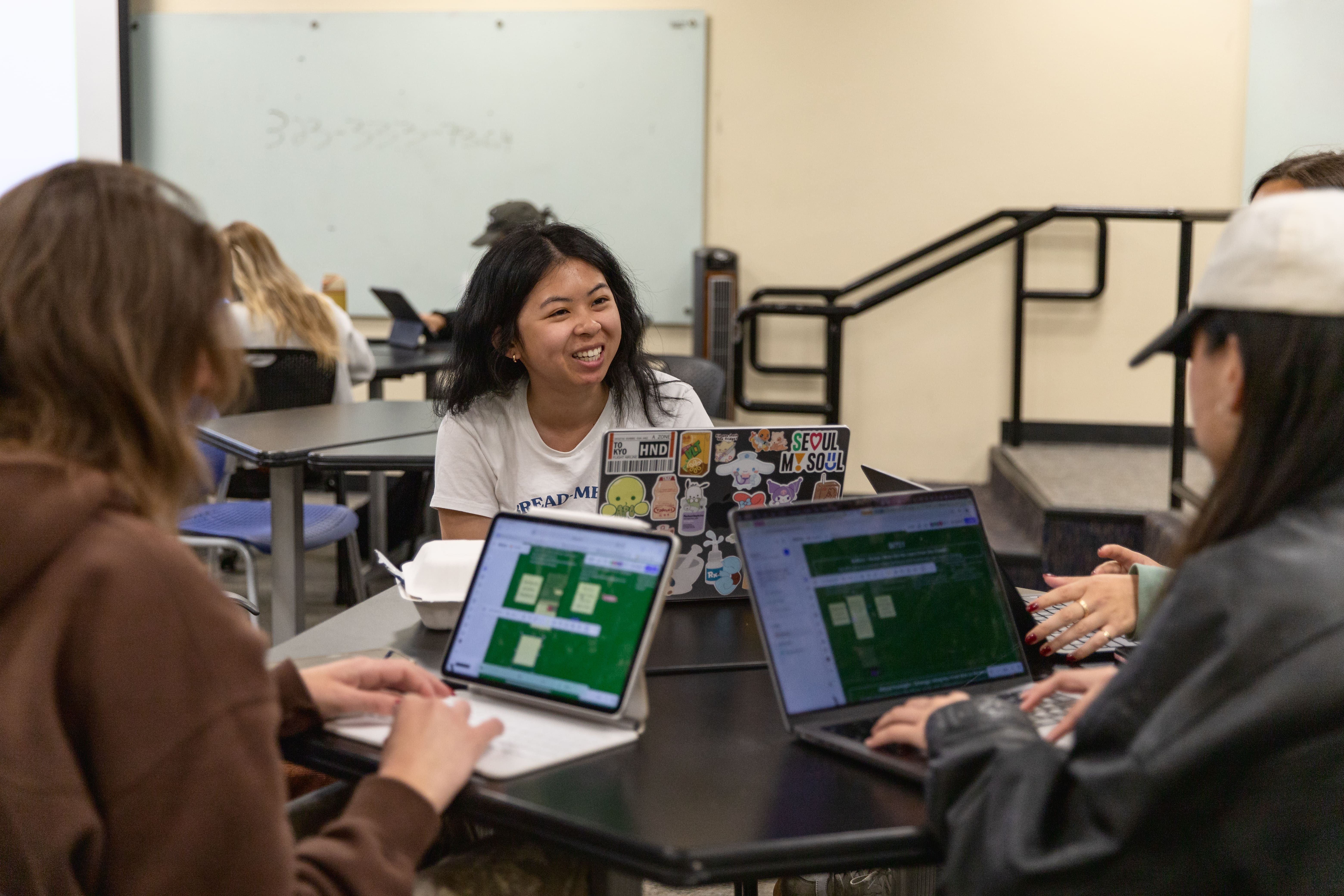
Many students who have witnessed the evolution have also been quick to embrace AI, knowing it will impact their futures. When Milana Byelick was a freshman, she said, AI was seen as a futuristic or experimental technology.
“Now it’s embedded in almost every tool we use,” said the information systems student. “I’ve also noticed a shift in attitude: People are less skeptical and instead are more curious about how to apply AI effectively. There’s also a growing awareness of the ethical and societal impacts of AI, which makes discussions more balanced and nuanced.”
Byelick is strategic director of the Information Systems Association, a club that recently hosted a talk from the chief artificial intelligence officer at Merck Pharmaceuticals. The club has also hosted an AI panel, attended at cybersecurity conference in San Francisco that discussed AI and hosted a workshop called AI in Action: How to Accelerate Your Career Path.

“Hearing from speakers who work directly in these AI-driven industries has given me a better view of how systems are built and implemented,” she said. “Club activities, such as workshops or case studies, also help me anticipate future trends by showing how AI is shaping business intelligence, cybersecurity and IT strategy.”
In an effort to help all students and faculty become more AI proficient, the Orfalea College of Business recently became the first Cal Poly college to establish an AI faculty fellow. Leida Chen, a professor in the Management, Human Resources and Information Systems Area, will help the college explore and integrate AI across teaching, research and practice.
“I believe every one of our business majors and concentrations is impacted by AI,” Chen said. “While the applications will be different, the underlying question remains the same, which is how we can leverage AI to make better decisions and improve human lives.”
“Universities have moved from treating AI as a threat to academic integrity to recognizing it as a foundational skill for learning, research and professional practice."
Stern Neill, marketing professor
Some faculty have already embraced AI not only in their classrooms but also their research.
Miranda Yin, assistant professor of marketing, recently published her article "Empathetic AI Encounters: Pathways to Prosocial Behavior” in Journal of Service Research. In the study, Yin and her co-authors suggested that consumers interacting with AI feel more connected when the AI voice expresses more empathy, seems to genuinely listen and responds warmly.
“As AI becomes more prevalent, human acceptance of it has also grown,” she said. “Earlier consumers often exhibited ‘AI aversion’ in domains such as healthcare and consumption, largely because AI was viewed as emotionless or lacking empathy.”
According to her research, 70 percent of travel agencies and 60 percent of hotels now use AI technology.
“AI literacy, or even AI proficiency, will be essential for the future,” Yin said. “Students need to understand not only how AI functions but also how to interact with and manage it effectively.”
The fact that businesses use AI-generated voices proves one fear of AI is valid: Organizations will replace some workers with the technology.
“They’re just using AI because it’s cheaper,” Kirk said. “So it’s kind of making the job market smaller, and we’re literally fighting against robots now.”
In other cases, AI could actually promote job growth.
The CPA Journal has recently characterized the accounting profession as being in a “severe crisis” due to lack of employees. But AI software, like Alteryx, which the Orfalea College of Business uses, can help attract more students to the profession by eliminating complex, intimidating functions, such as coding, said Chuancai Zhang, an assistant professor of accounting.
"Through Alteryx, students learn to automate routine tasks and solve data challenges at scale,” said Zhang, who has integrated the software into his lessons. “This elevated productivity means organizations can do more with their existing talent while allowing professionals to focus on higher-value work."
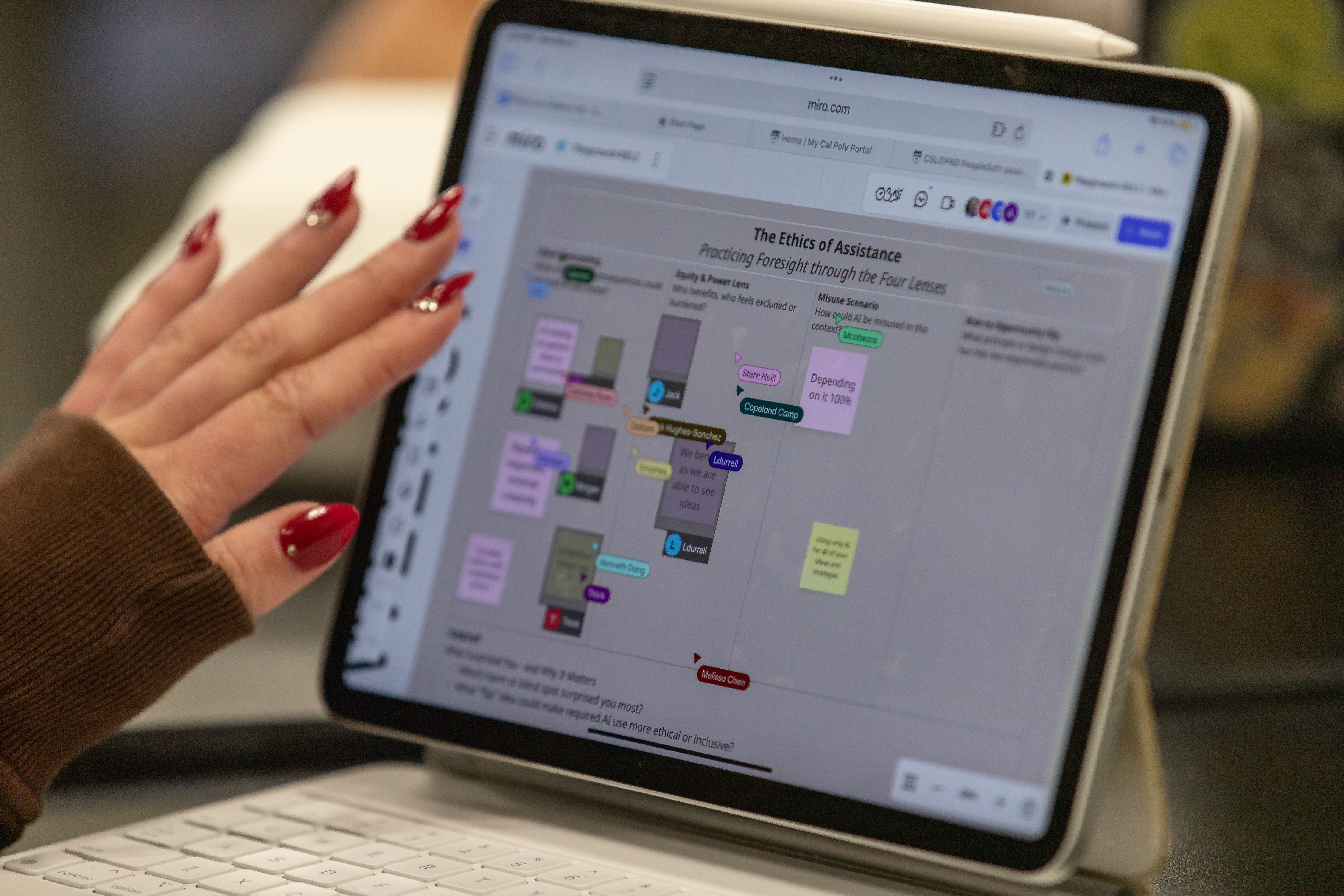
In his marketing class, Neill uses AI as a structured “thinking partner” to help students test assumptions, explore alternatives and strengthen client strategies -- enhancing, not replacing, human judgment.
Avery McCloughan a fourth-year marketing student in the class, said she’s witnessed faculty use AI tools more each quarter.
“It’s important to learn how to use them effectively rather than being shielded from being allowed to use them in school,” she said, noting that graduates will be expected to use AI in industry. “So it’s good to learn now.”
For marketing, AI can brainstorm ad concepts, generate images and graphics and suggest different voices for social media, among other things. McCloughan said that helps enhance her ideas, but she doesn't worry that marketing professionals will be replaced.
“Obviously AI can be creative,” she said, “but only to a certain extent. And I think individual thoughts will always be beneficial moving forward.”
Job loss is, of course, just one concern about AI, Chen acknowledged. Other fears include reservations about ethics, academic integrity, privacy, security and the environmental impact.
"Many also experience technostress, which refers to the feeling of being overwhelmed by new technologies, along with the practical constraints, such as limited time, training and support."
Chen's faculty fellow role was designed to help faculty and students benefit from AI.
"Our approach emphasizes building an inclusive culture of experimentation and developing support structures that allow faculty to learn, integrate and innovate with AI at a pace that works for them," he said. "Helping our community overcome these barriers is a central part of the AI faculty fellow's role."
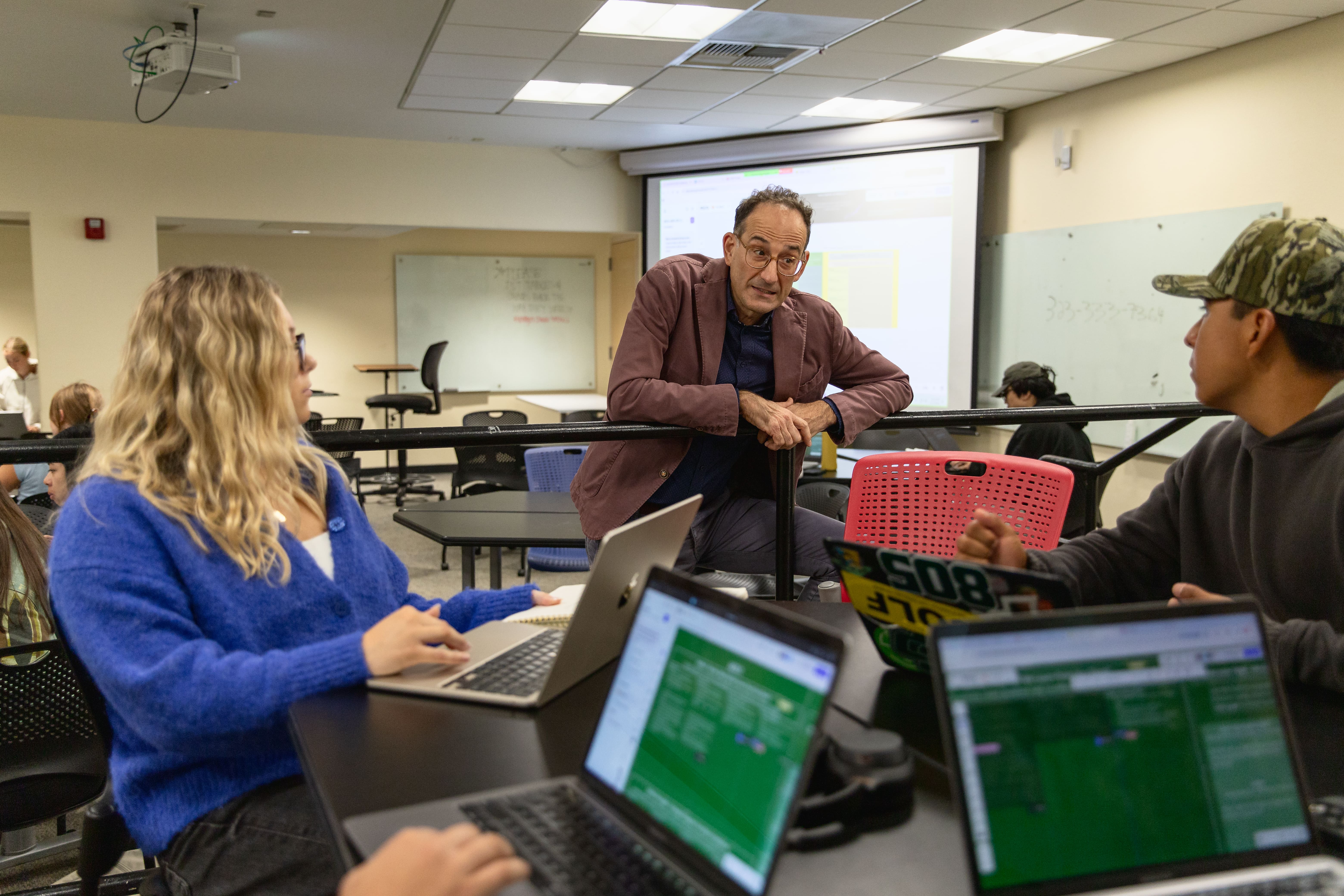
Top photo: Leida Chen, the AI faculty fellow for the Orfalea College of Business, teaches a class. In his AI role, Chen will help foster AI use in the classrooms and research. (Photo: Jahan Ramezani)
Your support for the Orfalea College of Business helps provide students with the technology needed to succeed in the workforce.

