
"Thoughtful Courage:" EY Recruiter Offers Advice on Leadership at the Workplace

When recruiting future leaders, Ken Bouyer seeks professionals with the right skillset and competencies, who will also have the courage to propose needed changes -- even when that’s difficult to do.
”If you're just with the status quo and, and you sit there and don't do anything, you don't have the ability to influence or shape the future,” said Bouyer, director of inclusiveness recruiting at EY Americas.
At the same time, he acknowledges, having courage isn’t easy.
“Just because you have courage doesn't mean you're not fearful,” he said. “You just have to find ways to push through.”
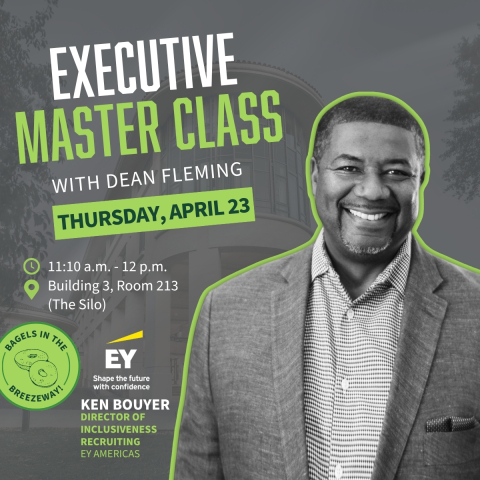
Bouyer will be the keynote speaker at the Matter Persist Belong Conference at the Multi-Activity Center on Friday, April 24 at 12:15 pm. Bouyer, a Manhattan College accounting alumnus who first joined Ernst & Young LLP in 1990, will also join Dean Damon Fleming for a master class on Thursday, April 23. (11:10 am-noon, the Silo).
The MBP Conference, an annual feature of the Multicultural Business Program, will also feature talks with Andrew Chuong of Zoom, Kayla McCarty from Disney and Ali Khan of Airbnb.
We asked Bouyer, who will discuss inclusive leadership and courage at the conference, how students should approach courage when they join the workforce.
There's probably a little bit of a fine line between being seen as having courage and being seen as a malcontent. A whiner. How do you balance that? If you're always complaining, then they’re going to roll their eyes at you every time you talk.
I have a saying, and the saying is simple: Not everything is a march-able offense. You have to pick and choose when you want to go to battle or when you want to fight something or when you want to push back.
And it can't be every day, every moment, because people will begin to tune you out and turn you off. So there is a fine line. Be thoughtful about it, pick the right time for you to step up and look to shape the future with confidence.
At the MBP conference, you're going to be speaking to some underrepresented students, who might be less inclined to have courage. What advice would you give to them? Because they're probably thinking, “I just need to lay low, not make any waves.”
I'm so glad you raised that because, frankly, as an underrepresented student and a first- generation student, that was my mindset in the early part of my career. And I'm going to encourage the students and challenge them: From early on in your career, you need to make sure you use your voice and make sure you're engaged with your organization.
And there's a saying -- I've got a lot of sayings -- I say, “Don't be happy just to be here.” If this organization hired you, that means you absolutely were great enough and good enough for the opportunity to be there. So don't be happy just to be in the building or with that organization. Make sure your presence is known and you're making an impact.
And do you think organizations value that as leadership potential?
I think so. Again, you have to be thoughtful, right? You can't be reckless with it. And know your environment. Be thoughtful about the comments you make or the pushback you're going to give. And absolutely at organizations, that's what we need. I don't want anyone on my team who does everything I want them to do and doesn't have an opinion.
The team won't be better, our solution won't be better. I need diversity of thought and perspective. And that's what all these students will bring to an organization. And so they have to have the courage to share their perspective.
Is there a particular way to exhibit courage that helps? I imagine you probably don't want to be too confrontational, but then again, you want to have conviction too.
Do your research and have facts to support your point of view. So if you disagree with the policy or if you disagree with a position a client may be taking, make sure you do your research. And make sure you present to the client why you think you know Roadway A is the right way to go instead of Pathway B that they're looking to take. So be thoughtful, do your research and present the facts.
How should job applicants show they have courage in their resumes and interviews? Especially if they're younger and they're just in college?
One, make sure your resume reflects who you are and your true story. You don't want to over-embellish your resume.
If you've done something, if you started an organization on campus while you were there, you did something pretty unique and interesting, make sure that's on your resume.
Some times people clearly kind of overinflate themselves on resumes. Is it easy for a professional like you to see through that?
There's still an interview process that you have to go through and the selection process. That person will have to eventually talk about what's on that piece of paper, and generally the truth always comes out. Be truthful about your experience, because why would you want to work for an organization that doesn’t want to hire you based on your actual background and experiences?
"There's a saying . . . 'Don't be happy just to be here.' If this organization hired you, that means you absolutely were great enough and good enough for the opportunity to be there. So don't be happy just to be in the building or with that organization. Make sure your presence is known and you're making an impact."
Ken Bouyer
When you were in college, you were very underrepresented -- and even when you started your career and probably even now -- and you always hear about the Imposter Syndrome and feeling sort of isolated. What was that like for you? What were the obstacles for you as a student and then starting out?
I could spend a whole hour talking about those things. I was always one of very few in my accounting classes at school. And then even when I started with the firm in our audit practice in 1990 in New York -- that's where I started the career -- there weren't a lot of people of color in my class.
So there were some adjustments I needed to make. And you said Imposter Syndrome? I definitely had that. There was no question. And there is a longer story to how I probably navigated it. But the long and short of it is I was fortunate to come across some good mentors who basically coached me through that Imposter Syndrome and really helped me get over some of the barriers and just coached and guided me.
I was fortunate to have people in the firm that took an interest in me, who coached me. Who mentored me, who helped me overcome some of the doubt and some of the confidence issues that I had.
Having a good support system is important.
One hundred percent. You can’t do this alone.


