
Immersed in Research

Remember building with LEGO bricks as a kid? A Cal Poly research project is testing whether those same bricks can help college students learn supply chain management and whether the fun of building is part of what makes it work.
The project was among more than 150 student research and creative projects showcased at Cal Poly’s annual SURP+ Research Symposium on Oct. 16. The event highlighted work completed through the university’s Summer Undergraduate Research Programs, including projects from students in the Orfalea College of Business.
Research posters filled the Engineering Plaza as students presented their findings to faculty, staff and visitors. Students from Cal Poly and three Central Coast community colleges, Cuesta College, Allan Hancock College and Santa Barbara City College, also participated.
During the annual program, students worked alongside faculty, staff and community partners throughout the summer, resulting in co-authored publications and collaborations among the university, industry and community groups.
Cal Poly's Office of Student Research and five of the university’s six colleges jointly organized the symposium, with participation from the California Central Coast Community College Collaborative.
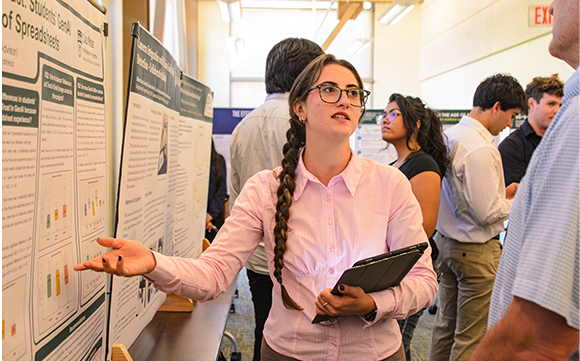
Inside a bright, windowed hall, students stood beside posters clipped to boards and propped on tables, walking faculty and visitors through charts, methods and findings. Many wore polos or button-downs. Some gestured toward specific sections of their posters as they explained their work, while others answered questions from small groups gathered around them. The steady hum of conversation filled the room as visitors moved from one project to the next.
Does a good match pay?
Anugraha Chris, a third-year quantitative analysis student, presented, on behalf of a two-person research team, how closely business alum occupations align with their field of study and what that means for their wages.
“We have a business major, and they enter the industry as a financial manager. That’s what we would consider to be a good match,” Chris said. “A poor match would be if that same business major ended up as a nurse.”
Through her research, Chris wanted to know whether aligning a college major with a career matters in the long term. Chris collected data from the American Community Survey and the National Longitudinal Survey of Youth and analyzed it in R, a programming language that helps analyze data, work with statistics and create charts and graphs.
The biggest finding was that students with higher GPAs tended to earn more when their jobs matched their skills and education.
“As your GPA increases, your estimated wage returns to having a good match increases,” Chris said.
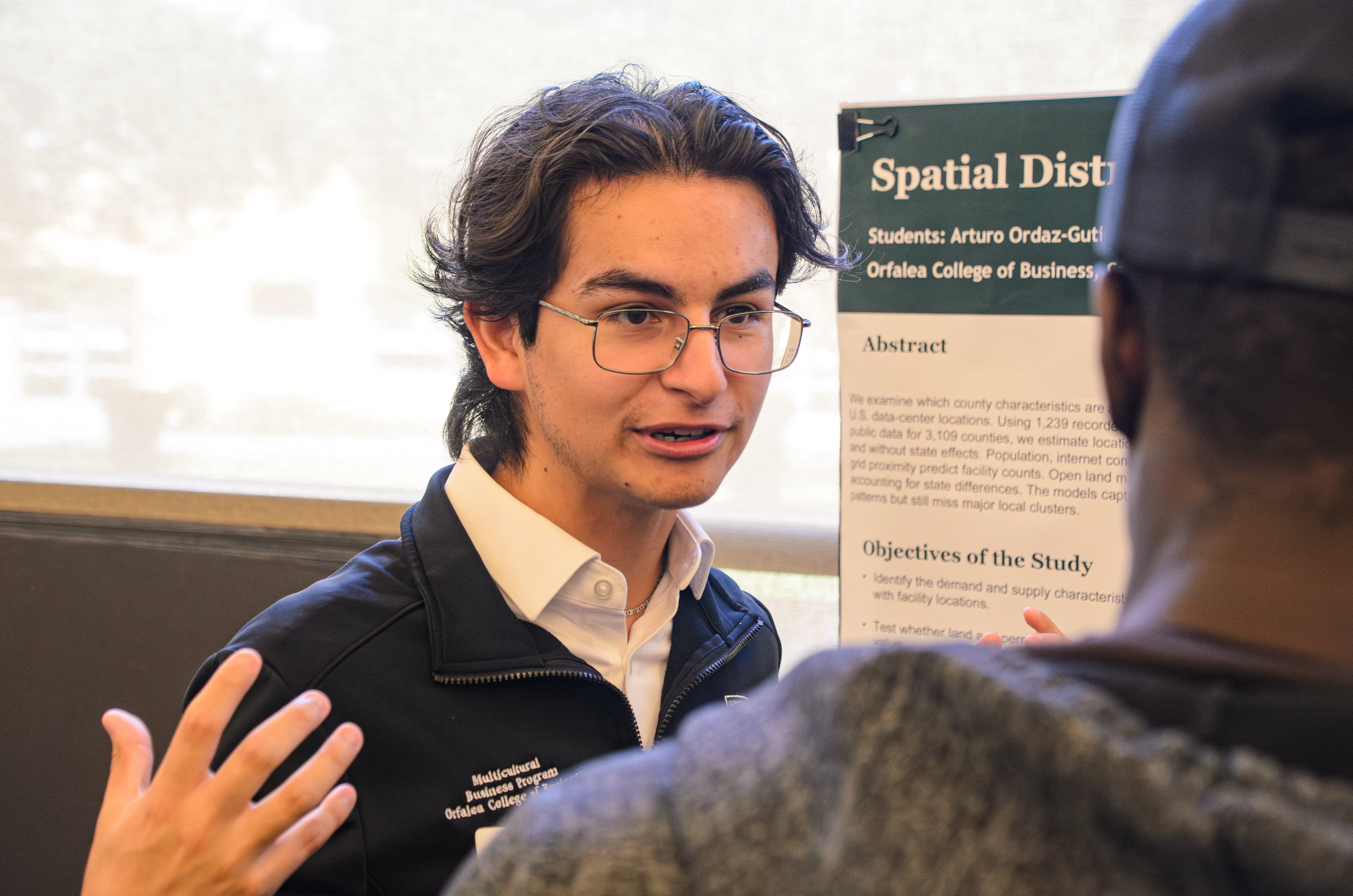
Chris said research taught lessons beyond data work.
“Technical skills are important,” she said. “They’re a valuable asset to have in a team or any employment. But it’s the way that you collaborate with people.”
Building with Legos
Jake Deelstra, a third-year industrial technology and packaging major concentrating in industrial technology, worked with Professor Ahmed Deif on research into LEGO Serious Play (LSP), a method for teaching supply chain management.
LEGO Serious Play is a group activity where someone asks questions and participants use LEGO bricks to build their ideas. The finished models help people share their thoughts, talk through problems and come up with solutions. Instead of just listening to a lecture, students learn by building, sharing and working together.
Deelstra’s research asked students to rate both methods from 1-5 on five measures: motivation, positive emotions, risk-taking, challenge mindset and action orientation.
“What we found on average was that LSP scored a lot higher than simulation across the board,” Deelstra said.
“It was definitely a tedious task trying to find all this different research,” Deelstra said.
At times, the papers did not support the idea Deelstra was trying to advance, which meant sorting through the research to find what fit best.
Deelstra’s main takeaway on the research was the need for patience.
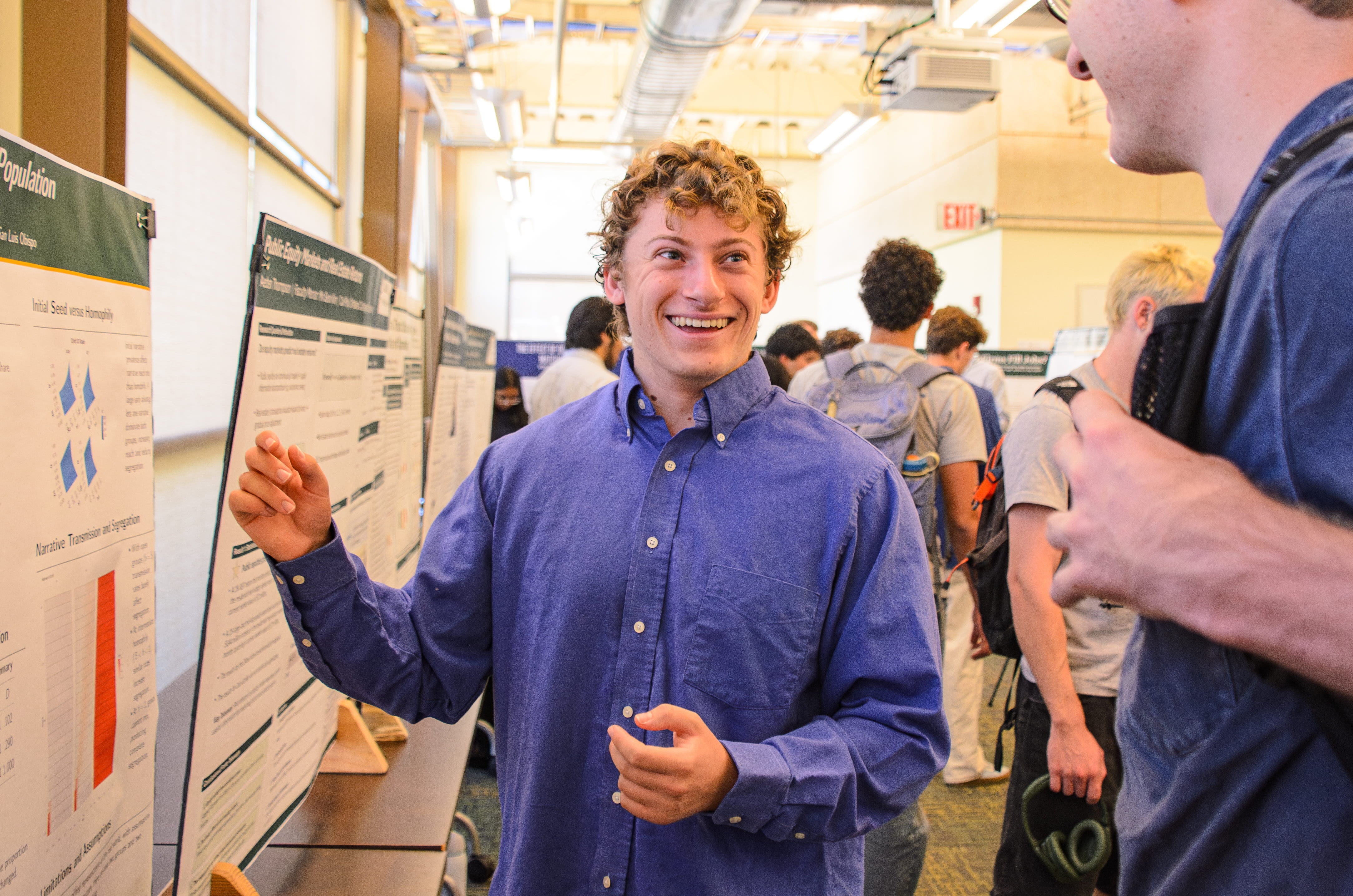
“There’s tons of stuff to notice within data,” Deelstra said. “If you can take your time with it and pinpoint what you’re looking for, you can find things that might prove what you’re trying to say, or maybe the opposite.”
The Hidden Costs of Flexibility
Tara Zarmandily, a third-year business administration student, and Brooke Castro, a fourth-year business administration student, both concentrating in marketing, found that consumers see part-time employees as more dehumanized than full-time workers, largely because they perceive them as having less time commitment and dedication.
Their research, titled “The Hidden Costs of Flexibility,” focused on showing a gap in existing research. Most of the articles they found covered either part-time versus full-time hiring or general consumer perceptions of companies.
“We had to mesh those articles we found together to support our research moving forward,” Castro said.
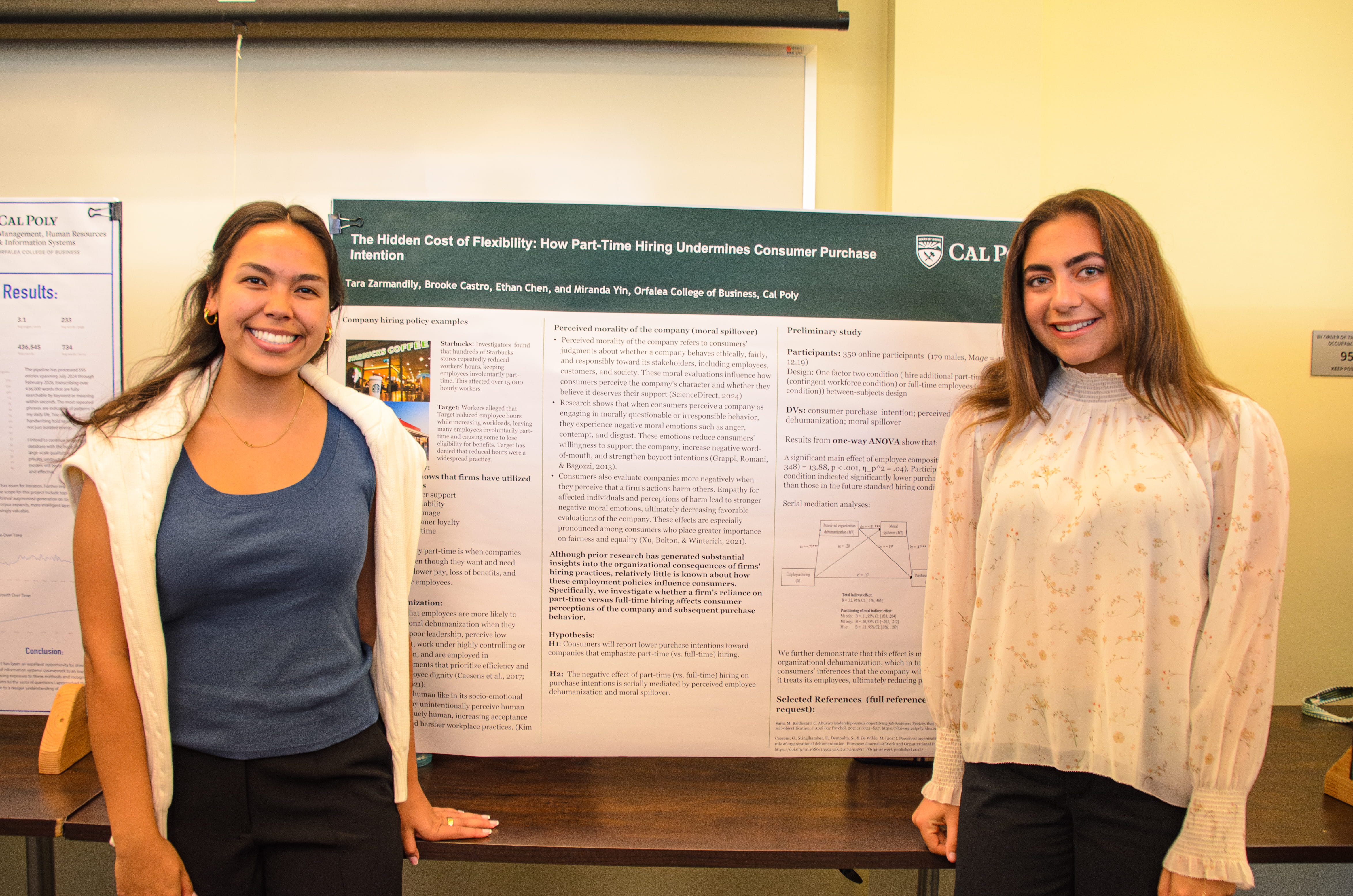
Zarmadily said the research gap made sources hard to find.
“Sometimes it would be a little difficult finding some sources when it came to this topic,” Zarmandiy said. “But making sure to weed out all the ones that seem accurate enough with data that’s more up to date is really important.”
Castro said the topic's abstract nature was a challenge.
“This whole research topic is very abstract, and so trying to quantify it was an obstacle for me,” Castro said. “But Professor Yin did a great job explaining it.”
The pair kept a weekly Excel spreadsheet for their data and analysis.
“Every week we would put in all our data and our analysis through there,” Zarmadilli said. “It taught me a lot about being very detail-oriented and making sure to catch things early on.”
Castro agreed.
“I second that, being detail-oriented and very thorough, so everyone’s on the same page,” Castro said.
What they learned
The research projects spanned wages, classroom games, AI, consumer psychology and more, but each student described a common thread: the hardest lessons of research had little to do with the subject matter and more with the process.
For Chris, it was learning to work with people and ask questions. For Deelstra, it was the patience to look closely at the data. For Zarmadilli, it was staying organized enough to catch problems early. And for Castro, it was how much commitment research demands.
That exposure to research— and the hands-on experience — is a primary objective of the program, said Bruce Greenbaum, associate dean for programs and learning.
“While each project may ask students to perform different tasks — from reviewing past literature in order to gain a better understanding of the current knowledge base of a topic; to data collection and cleaning to support initial analysis; to performing data analysis and generating preliminary results— the goal is to immerse students in the research process,” he said.
Your support for programs like SURP allows students to learn both inside and outside the classroom.


