
"The Landscape is Changing Rapidly:" How Artificial Intelligence is Impacting the Job Search for New College Graduates

While experts say artificial intelligence is increasingly transforming the job search, Yasna Mukundan purposely avoided AI when she crafted her cover letters. But as a career peer advisor at the Orfalea College of Business, she knows students are using the technology –- and the results aren’t always good.
“With cover letters, you can really tell if they are using AI,” said the graduating finance student. “I think if you can clearly tell that a cover letter is written by AI, it shows you didn’t really put that much thought into it.”
As many graduating students begin their job hunt, experts say AI has become a major factor in that process, with both employers and applicants using it.
“AI and generative AI are increasingly embedded in applicant tracking systems,” said Ben Alexander, associate professor of management. “For example, major applicant tracking systems can conversationally guide applicants and help organizations screen applicants.”
According to TopResume, more than 60 percent of companies embrace AI tools as some part of their recruitment or hiring process. That includes writing job ads, drafting interview questions and automatically contacting candidates for interviews. Meanwhile, according to recruiter Career Group Companies, two-thirds of job candidates in a 2025 study used AI for functions such as resume and cover letter writing, interview practice, career guidance and headshots.
Fifty-four percent of US job seekers surveyed by recruiting software firm Greenhouse said they have had an AI-led interview. And a recent Forbes piece described a wide expansion of AI, where machine learning algorithms instantly analyze skills and behavioral patterns, assess verbal and non-verbal cues during interviews and even offer negotiations.
“The landscape is changing rapidly,” Alexander said.
For future human resources professionals, that change requires not only learning about the technology but also its potential for biases.
“In the U.S., there is no single federal law addressing AI use in HR, though the applicability of federal non-discrimination law is unaffected by the technology,” Alexander said. “Various states have laws regulating AI in personnel practices, including California, which has among the most restrictive standards in the U.S. specific to AI. Federal executive orders are also shaping the HR environment and, over time we will see more relevant case law that helps employers and applicants navigate personnel processes embedded with these new technologies.”
While human resources faculty have to keep apprised of the latest research, college career advisors have to assist students applying for internships or career jobs in a fast-evolving AI world.
“I have had students share with me that during a virtual interview, the student received an AI summary as well as AI-appointment scores in their answers,” said Matt Parks, a Cal Poly career counseling specialist and liaison for the Orfalea College of Business. “Within some platforms, such as LinkedIn, there are embedded AI chatbots that a recruiter can ask to find candidates meeting certain qualifications and have specific qualities.”
“I think if you can clearly tell that a cover letter is written by AI, it shows you didn’t really put that much thought into it.”
-- Yasna Mukundan, career peer advisor
Kristin Beal, a graduating finance student, said she had virtual job interviews where she spoke to a screen as her answers were recorded.
“It was not as natural, as conversational, and there are no verbal cues, so it’s just different,” said Beal, who is also a career peer advisor.
More commonly, companies use AI to scan resumes for keywords, hoping to solicit candidates that match job descriptions.
“This matters because the terms signal that an applicant both speaks the same language as someone in the role and has read the job post carefully,” Alexander said.
While older tracking systems scanned for specific keywords to sort and rank candidates, he added, newer systems using large language models are less reliant on exact keyword matches and better understand context, synonyms and the broader meaning behind what applicants write.
Cal Poly’s Career Services recently launched BigResume, which allows candidates to submit both their resume and the job description of an opening, offering advice on how to optimize the resume for compatibility with applicant tracking systems.
While the hiring process is evolving, Parks cautions against too much AI strategy and guessing.
“Do not obsess over this,” he advised.
Some applicants, he said, have tried to game AI with tactics such as “white font,” where they add numerous keywords to a resume, then switch the font color to white so human reviewers don’t see them.
Mainstays, like consistent and clean formatting, are still important, Parks said. And he advises job hunters avoid using profile photos and icons, which AI might throw off AI reviews.
When candidates all use AI, cover letters and resumes all begin to look similar. So for resumes and cover letters, Mukundan suggests using AI to workshop the human writing.
“Obviously, don’t have AI write it for you because then it’s not that good,” she said. “But as long as you’re using it as a tool, I think that’s fine.”
Having completed multiple credit and private equity internships, Mukundan had plenty of keywords in her resume that matched the commercial banking job she landed with Capital One in McLean, Virginia.
“I think for my resume, my experiences really carried me,” she said.
Beal, her colleague in the Orfalea College Career Services Center, applied for around 70 jobs, Because finance jobs can vary, she was careful to tailor each resume to the job.
“If the job responsibilities were vastly different, I would change my keywords,” she said.
To help, she entered the job descriptions through AI, rewording her resume to match the keywords it generated.
One piece of advice she offers applicants is to offer specific metrics – numbers that back a resume’s claims.
Using AI as an advisor, Beal landed a job as a financial development program analyst with Intuitive Surgical in the Bay Area.
While she witnessed AI being used in the job search, she thinks it’s still a nascent technology.
“I don’t think they’re relying on it much yet,” she said. “So I think I’m in the sweet spot of getting in between it. I was just aware of optimizing my resume if they are using AI to look for bullets but not obsessively looking into it.”
While AI also threatens recruiter jobs, at conferences and career fairs, Parks said, he has heard that employers are often still using human review for applicants.
But the future is unclear.
“Many shared that they use AI as an aid but not the only means for review,” he said. “With that being said, I have had students who apply to larger companies and organizations report back that they received nearly immediate rejection emails, which can be an indicator that their application was reviewed by AI only.”
Charlie Nichols contributed to this story.
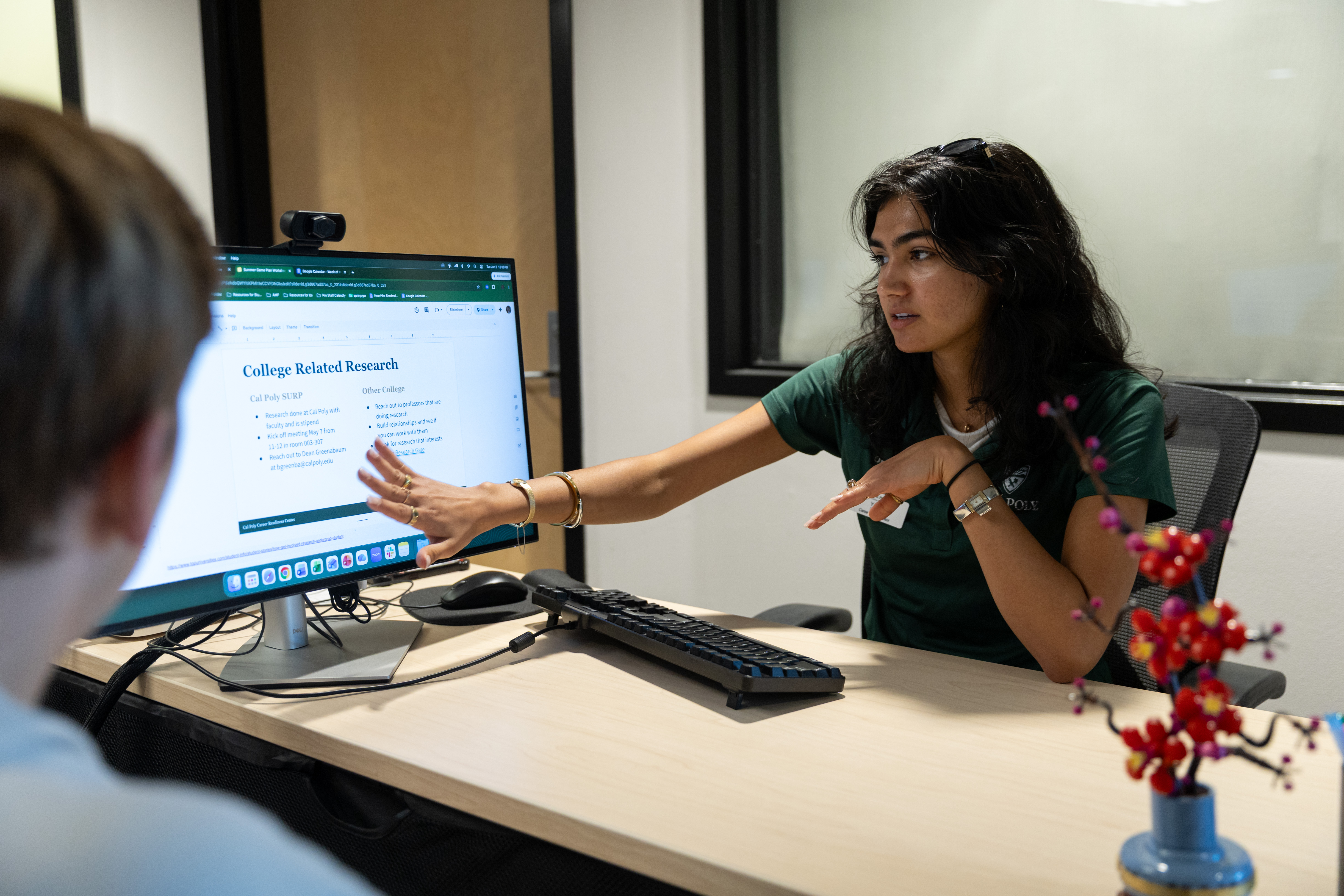
Top photo: Suvida Nambooridi, a lead career advisor, assists a student at the Orfalea College of Business Career Readiness Center. (Photo: Jahan Ramezani)


