
Will Robots Take Our Jobs? Two Students and a Faculty Mentor Researched Human Skills That Will be Desired in the AI Era

As artificial intelligence automates many of the routine, time-consuming workplace tasks, human skills will actually become more essential on the job, said a management and human resource lecturer and career coach. And, to prepare for a newly aligned work world, Alexa Loken said, students should look to humanities courses, like public speaking, to build needed skillsets.
“People need to continue to talk with each other,” said Loken, who also teaches public speaking in the Communication Studies Department. “Many people are still understandably nervous about speaking in front of a group, but the ability to communicate clearly — in small groups or to larger audiences — will remain enormously valuable.”
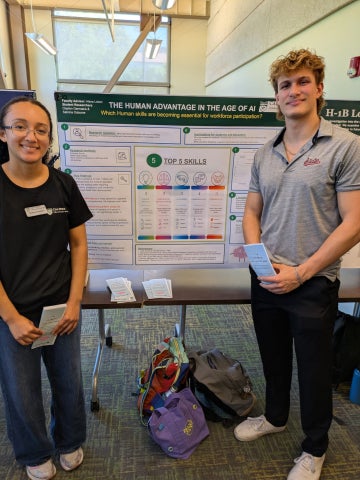
To get a sense of what human skills will be in demand as AI continues to evolve, Loken and two students from the Orfalea College of Business conducted a survey of 90 working professionals, many of them managers, across various industries and paired those results with additional research. The findings, presented during the Summer Undergraduate Research Symposium, identified five human strengths that will be essential in the AI future: critical thinking, judgment, adaptability, communication and collaboration.
The research was conducted as AI is causing many to fear its impact on employment.
“That is very distressing for a lot of people,” Loken said. “This is kind of like when the Internet went mass market. It’s just another technological moment where people have to adapt.”
Loken, who is an educator as well as the founder and principal of Loken Careers, thinks AI will possibly prompt young professionals to skip some of the more entry-level tasks.
“AI may take on more editing, summarizing, searching and routine analysis, while people spend more time evaluating the information, communicating meaning, solving unfamiliar problems and making the final decisions,” Loken said. “As AI becomes more capable, human oversight and judgment become even more important, not less.”
The Summer Undergraduate Research program pairs faculty mentors with students to conduct relevant research. During their work, Loken’s students sent surveys to professionals in tech, government, education, health care and a variety of other fields. Areas most impacted by AI, respondents noted, included data analysis, technical work and content creation. Human skills, such as empathy and leadership, were considered valuable.
While educators might have concerns about AI – and Loken admits that she has her own – universities can’t fall behind in preparing students for technological advances.
“AI is not going away anytime soon,” Loken said. “Universities shouldn't simply leave students to figure it out alone — or to learn about it only from the companies building and selling these tools. We as teachers have a responsibility to help students understand when and how to use AI well, while grappling with its limitations, ethics, environmental costs and broader social effects.”
While there is a perception that younger people are more receptive to technology, Loken, who works with older, more established professionals in her coaching career, said seasoned professionals have actually embraced AI.
“In my professional experience, many seasoned professionals have been especially ready to engage with AI," she said. "They have already adapted to multiple waves of technological change and often see it as another tool they need to understand.
There is a sense of mistrust and competition among younger Americans, and many recent college graduates believe AI is responsible for the higher unemployment rates for entry-level jobs. But Clayton Germaine, one of the two students who worked on the project, said he doesn’t fear AI, he sees it as a tool.
“Throughout the research that we conducted this last summer, I would definitely conclude that ‘avoiding’ AI doesn’t exactly make you more valuable to employers,” said Germaine, a finance student. “With that being said, it’s crucial for people to not fully rely on it, as the human deskilling risk is real and very much apparent.”
AI technologies can be biased and incorrect, he said, making it important for humans to use critical thinking alongside it – and to be able to communicate well.
“AI may take on more editing, summarizing, searching and routine analysis, while people spend more time evaluating the information, communicating meaning, solving unfamiliar problems and making the final decisions. As AI becomes more capable, human oversight and judgment become even more important, not less.”
-- Alexa Loken
“It’s crucial to take Communications: Public Speaking as seriously as possible,” he said. “The course is often disregarded as some general education that students just want to get out of the way, and, for the most part, public speaking is many college students’ worst fear. Especially with AI now being used, being able to communicate clearly and collaborate with others is an incredibly enriching skill that many students may instinctively avoid.”
Sabrina Osborne, an accounting student who worked with Germaine on the research, said AI will provide accounting professionals more time to make managerial decisions that help solve more significant problems. The five key human skills they highlighted should help.
“I plan to focus on the ways I can improve these skills for my own professional development,” she said. “I want to continue doing research to improve the methods and laws we rely on to problem solve in the accounting industry.”
She has already gained confidence in an AI workforce with a variety of courses that have aided her human skills.
“Courses such as African American Literature, Introductory Statistics, Organizational Behavior and Finite Mathematics have truly helped me learn and practice these skills,” she said.
Still, fears of AI will persist. Recently, leaders in the field, in startling words, cautioned that the industry needed to slow advancement of AI to ensure public safety. While that concerns Loken, she thinks humans are creative, adaptable and ingenious and will use AI for positive societal outcomes.
“I don’t think the most useful response is doom and gloom,” Loken said. “This is a moment to lean in thoughtfully, work together and figure out how to use these tools in ways that strengthen — not replace — human judgment and connection.”
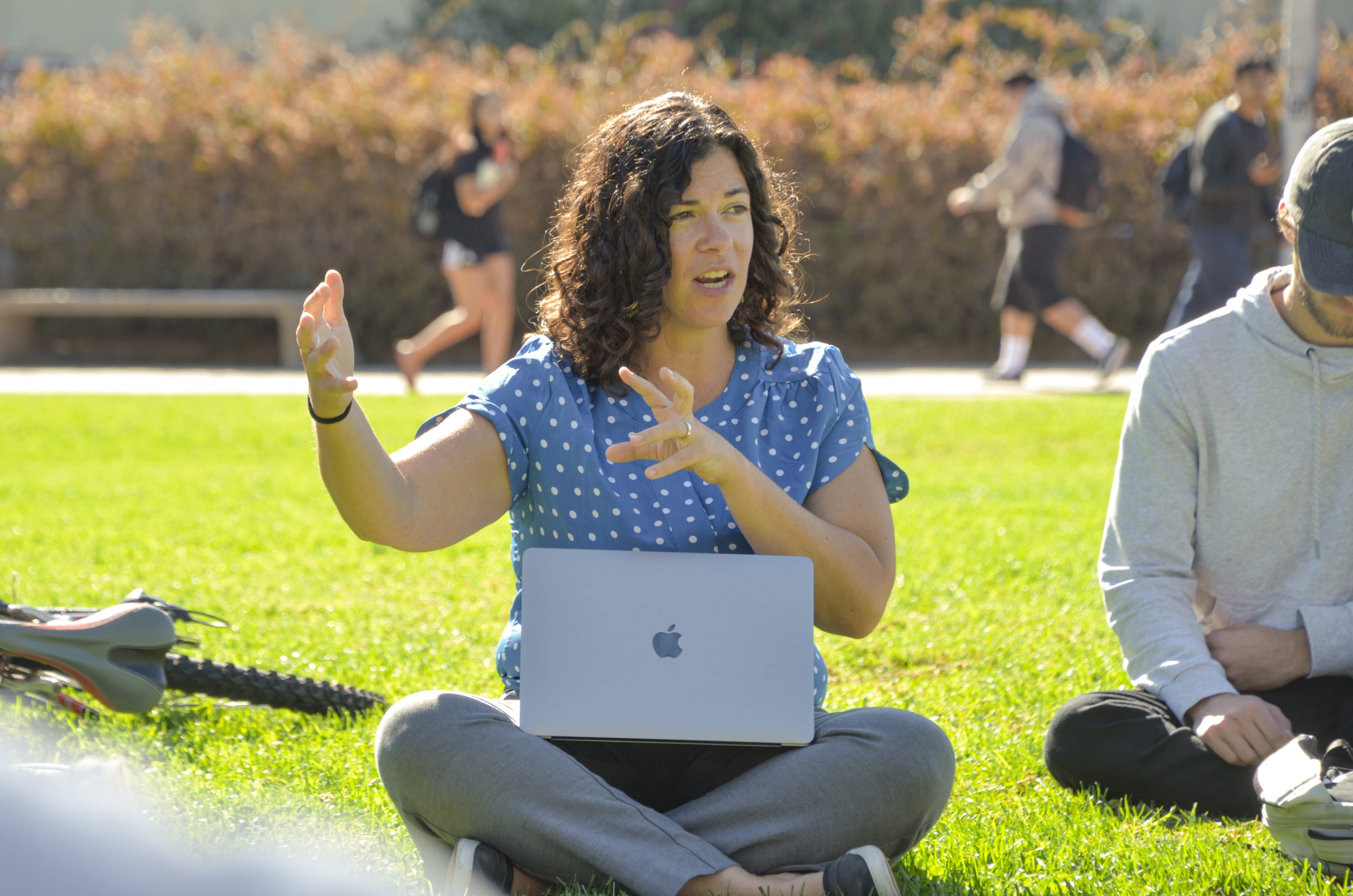
Top photo: Alexa Loken teaches her management and human resources class. (Photo: RIntaro Sato)


